

Building a Forex Brokerage Technology Stack from Scratch (2026)
A complete guide to the six layers of forex broker infrastructure — trading platform, liquidity, CRM, payment processing, compliance tooling, and client-facing applications — with a make-vs-buy decision framework and first-year cost estimates.
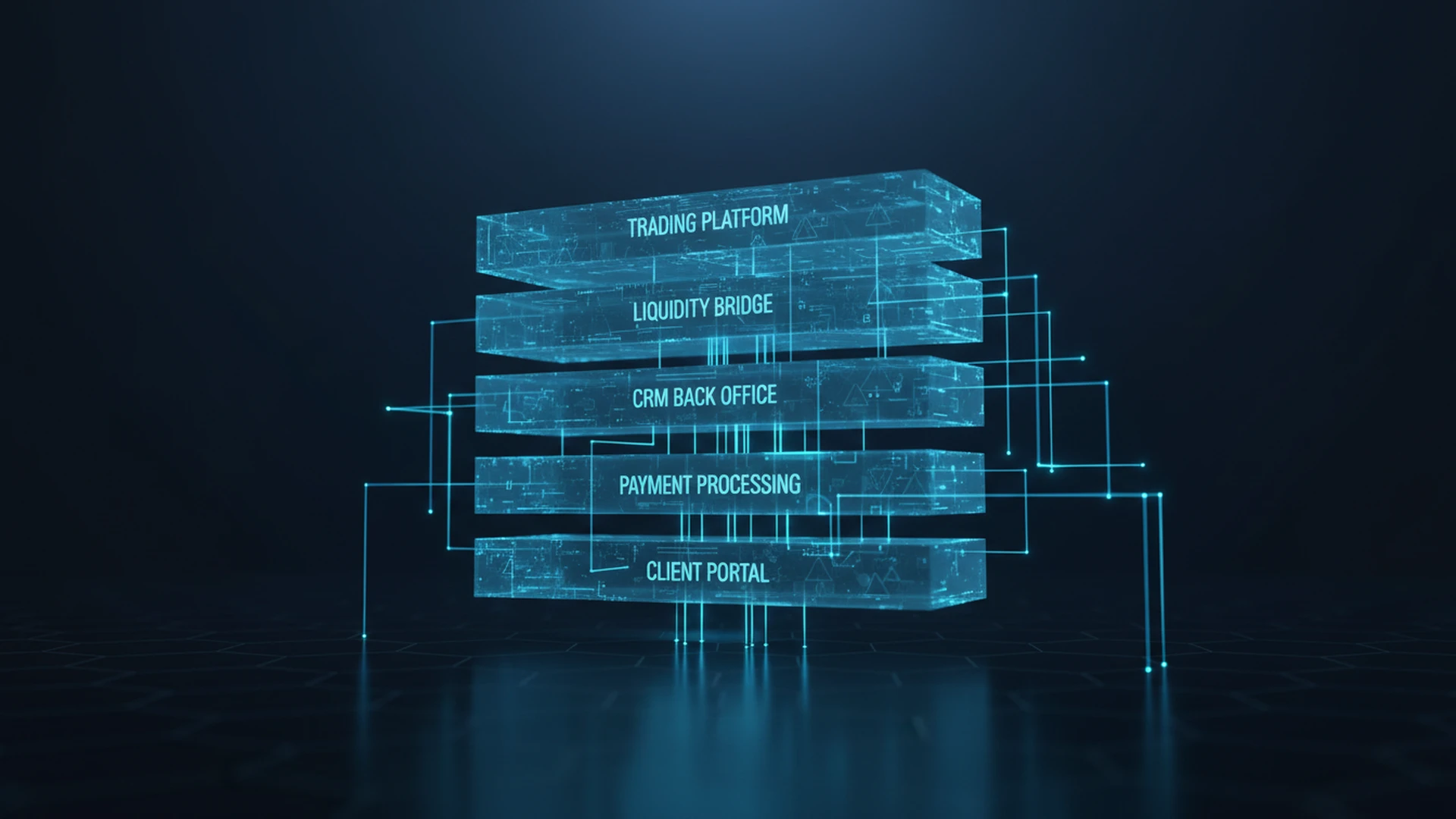
A forex broker technology stack in 2026 has six layers: trading platform (MT5®), liquidity and connectivity, CRM and back office, payment processing, compliance and KYC/AML tooling, and client-facing applications. First-year infrastructure costs range from approximately $90,000 to $480,000 as of Q3 2026 — with the CRM make-vs-buy decision and trading platform licensing model being the two largest variables.
The Six Layers of the Forex Brokerage Technology Stack
A complete forex brokerage technology stack has six layers: the trading platform (MT5®), liquidity and connectivity infrastructure, CRM and back office, payment processing, compliance and KYC tooling, and client-facing applications. Every layer connects to the CRM as the operational hub. For a vendor-by-vendor breakdown of each layer’s software options, see the complete forex software guide.
Layer 1 — Trading Platform
The trading platform is the core execution infrastructure. It handles order routing, trade execution, position management, and the client-facing trading interface. Every other component in the stack connects to the trading platform.
MT5® is the current standard for retail forex brokerages globally. It supports more instruments, has a more capable Manager API, and is the platform MetaQuotes is actively developing. MT4® licences are no longer available from MetaQuotes for new brokers — a new brokerage requiring MT4® should acquire it from an existing licence holder, which carries significant additional complexity, cost, and dependency risk.
Deployment options for MT5®:
- Full server licence (directly from MetaQuotes): Complete ownership of the server infrastructure. Full control over configuration, server settings, and execution parameters. Required for brokers who want zero dependency on a third-party host.
- White label (through a licensed third-party provider): MetaQuotes has paused direct white label issuance to new brokers. White labels are available through licensed third-party providers. Faster setup but with configuration limitations and host dependency.
- cTrader: An alternative platform with a strong reputation among retail traders, particularly in the copy trading market. Available as white label through Spotware.
Cost: MT5® full server licence: from approximately $10,000 upfront (one-time), plus ongoing operational and hosting costs of approximately $2,000–$10,000 per month depending on account volume and infrastructure. MT5® white label (third-party provider): setup $5,000–$15,000 + $1,000–$5,000 per month.
Layer 2 — Liquidity and Connectivity
Liquidity infrastructure determines the quality of execution the brokerage can deliver to clients. Most retail forex brokers operate a hybrid A-Book/B-Book model: flow that meets risk management criteria is hedged with a prime broker (A-Book), while flow that does not meet those criteria is internalised (B-Book).
Prime brokerage / liquidity provider: The upstream counterparty for hedged flow. Prime of prime (PoP) providers like IS Prime, Sucden Financial, and Advanced Markets aggregate liquidity from multiple tier-1 banks and make it accessible to brokers who do not qualify for direct prime brokerage relationships. Minimum capital requirements for PoP relationships range from $500,000 to $2,000,000 as of 2026 — verify directly with prospective providers.
MT5® Bridge: The technology that connects the trading platform to the liquidity provider for A-Book execution. The bridge routes selected trades to the LP for hedging in near-real-time. Standard bridge providers include PrimeXM, oneZero, and Centroid. Bridge technology costs $2,000–$5,000 per month.
Risk management system: The system that makes the A-Book/B-Book routing decision in real time. Some brokers handle this logic in the bridge configuration; others use a dedicated risk management platform (Gold-i, PoP Risk). The risk management system determines profitability for the B-Book portion of the flow.
Layer 3 — CRM and Back Office
The CRM is the operational hub of the brokerage. It connects client management, KYC/AML workflow, IB and commission management, payment processing, and the trading platform data in a single system. Every client interaction flows through the CRM.
The make-vs-buy decision for the CRM is one of the most consequential choices a new brokerage makes. SaaS platforms provide the fastest path to launch; custom development provides more capability and lower long-term cost at scale. For the full comparison framework, see our custom vs. SaaS guide and CRM cost analysis.
Key CRM capabilities required:
- KYC/AML onboarding with document management and automated verification
- Multi-tier IB management with configurable commission structures
- MT5® account creation and real-time synchronisation
- Payment processing integration (multi-PSP)
- Client portal with account management and funding interface
- Compliance audit trail and regulatory reporting
- Automated client communication (email, push notifications)
For a technical deep dive into how a custom CRM is built, see our forex CRM development guide.
Layer 4 — Payment Processing Infrastructure
Payment processing is how clients fund their accounts and how the brokerage pays withdrawals. The payment infrastructure must support multiple methods — card, e-wallet, bank transfer, and increasingly crypto — with automated reconciliation against the CRM transaction ledger.
A minimum viable payment stack for a new retail brokerage includes: one primary card-acquiring PSP, one e-wallet integration (Skrill or Neteller), and a bank transfer option for larger deposits. Crypto support is increasingly expected by the retail trading demographic.
The critical architecture decision is where payment processing logic lives. In a well-designed system, the CRM handles all transaction orchestration: creating the payment request, routing to the appropriate PSP, receiving the webhook confirmation, crediting the trading account, and recording the transaction. In a poorly designed system, these steps are distributed across multiple tools with manual handoffs — which breaks at volume.
See our complete forex payment gateway integration guide for the full architecture detail.
Estimated PSP setup costs: Card acquirer setup $2,000–$10,000, e-wallet integrations $1,000–$3,000 each, transaction fees 1–3% per deposit.
Layer 5 — Compliance and KYC Infrastructure
Regulatory compliance is a cross-cutting concern in the technology stack, but the dedicated compliance infrastructure — identity verification, sanctions screening, and transaction monitoring — sits as its own layer.
KYC/AML providers: Automated identity verification services (SumSub, Onfido, Jumio) perform document verification and facial recognition for new client onboarding. These APIs are integrated into the CRM’s onboarding workflow. The brokerage pays per verification — typically $1–$5 per check depending on volume and service level.
Sanctions and PEP screening: Real-time screening of new and existing clients against global sanctions lists and politically exposed persons lists. This is typically provided by the same vendor as the KYC provider or as a standalone service (Dow Jones Risk & Compliance, Refinitiv World-Check).
Transaction monitoring: Rule-based monitoring of deposit and withdrawal patterns for suspicious activity. Basic transaction monitoring can be built into the CRM directly; more sophisticated monitoring requires a dedicated TMS platform.
Layer 6 — Client-Facing Infrastructure
The client-facing layer is what clients see and interact with directly: the client portal, the trading applications, and the communication channels.
Client portal: The web application where clients register, complete KYC, manage their accounts, deposit and withdraw funds, and access trading history. This is typically provided by the CRM vendor (as a white-label or configurable portal) or built as a custom web application.
Trading applications: The MT5® desktop terminals, mobile apps, and web trader are provided by MetaQuotes for licensed MT5® operators. White label terms include the branding of these applications.
Communication infrastructure: Email delivery (Mailgun, SendGrid, AWS SES), SMS notifications (Twilio), and push notifications for the mobile trading app. These are integrated with the CRM to trigger automated messages at defined workflow points.
Affiliate and IB portal: A dedicated interface for introducing brokers showing their downline activity, commission earned, and marketing materials. This is either a module within the CRM or a separate application.
The Supporting Infrastructure Layer
The supporting infrastructure layer covers cloud hosting, CDN and DDoS protection, application monitoring, and backup and disaster recovery — the operational foundation every forex broker stack requires regardless of the application components chosen.
Behind the application stack, the brokerage needs operational infrastructure:
Hosting: Cloud infrastructure (AWS, Google Cloud, Azure) for CRM, client portal, and payment processing components. The MT5® server infrastructure is typically hosted in a co-location data centre with low latency to the primary liquidity provider.
CDN: Content delivery for the client portal and marketing website. Cloudflare provides both CDN and DDoS protection.
Monitoring and observability: Application performance monitoring (Datadog, New Relic), uptime monitoring, and alerting for infrastructure and application events.
Backup and disaster recovery: Daily database backups, point-in-time recovery capability, and a documented disaster recovery plan. CySEC and DFSA both require evidence of business continuity arrangements as of 2026 — verify current obligations with qualified legal counsel.
Sequencing the Build: What to Prioritise
Build in three phases: trading platform + CRM + one PSP first (months 1–4), then IB management, full PSP stack, and client portal polish (months 4–7), then risk management, A-Book/B-Book bridge, and analytics (months 7+).
For a new brokerage assembling this stack from scratch, the sequencing matters as much as the component selection. The most common mistake is attempting to run all components in parallel, which creates integration chaos and delivery delays.
Phase 1 — The critical path (months 1–4): Trading platform setup, CRM with basic KYC/AML onboarding, and one PSP integration. These three components must work together reliably before anything else is added. This is the minimum viable brokerage stack.
Phase 2 — Operational completeness (months 4–7): IB management and commission calculation, full PSP stack (card + e-wallet + bank transfer), enhanced KYC/AML automation, client portal polish, and email communication workflows.
Phase 3 — Scale and optimisation (months 7+): Risk management system, A-Book/B-Book bridge configuration, crypto payment processing, loyalty and promotion tools, advanced reporting and analytics, and affiliate portal.
Regulatory compliance must be integrated throughout — not added as a phase. A brokerage that defers KYC/AML or client money segregation to a later phase creates regulatory risk that can delay or prevent the licence grant.
Make vs Buy at Each Layer: A Decision Framework
License the trading platform, liquidity, and KYC/AML layers — building them from scratch is prohibitive. The meaningful make-vs-buy decision is at the CRM layer, where SaaS provides faster launch and custom provides lower long-term cost above 1,500–3,000 active accounts.
Not all layers have a meaningful make-vs-buy decision. Trading platform, liquidity, and KYC verification are almost always licensed. The critical decision is at the CRM layer, where the capability gap and long-term cost difference between SaaS and custom are largest.
| Layer | Buy (SaaS/White Label) | Build (Custom) |
|---|---|---|
| Trading platform | White label (fast, dependent) | Full licence (control, cost) |
| Liquidity | PoP (mandatory unless large) | Direct prime (requires scale) |
| CRM | SaaS (fast, limited) | Custom (flexible, owned) |
| Payment processing | PSP APIs (always external) | Custom orchestration layer |
| KYC/AML | Third-party APIs (standard) | In-house only at large scale |
| Client portal | CRM-bundled (fast) | Custom (differentiating) |
For the full CRM cost comparison and crossover analysis, see our custom vs. SaaS guide.
Total Technology Infrastructure Cost: First-Year Estimate
First-year technology infrastructure costs for a new retail forex brokerage range from approximately $90,000 to $480,000 as of Q3 2026, with the CRM choice (SaaS vs custom) and trading platform licensing model being the largest variables. The lower bound assumes a third-party MT5® white label with an entry-tier SaaS CRM; the upper bound assumes a full MT5® licence with an enterprise CRM deployment.
Figures are approximate and for illustrative purposes only. Actual costs vary significantly by provider, jurisdiction, and scope.
| Component | Annual Cost Range |
|---|---|
| MT5® white label — third-party (annual licence) | $12,000–$60,000 |
| MT5® white label — setup fee (one-time, year 1) | $5,000–$15,000 |
| MT5® full licence — operational costs | $24,000–$120,000 |
| CRM (SaaS, entry to mid-tier) | $24,000–$200,000 |
| CRM (custom build — five-year amortisation plus operating cost) | $47,000–$89,000 |
| Bridge / connectivity | $24,000–$60,000 |
| PSP integrations (setup) | $5,000–$20,000 |
| PSP transaction fees | Variable (1–3% of deposits) |
| KYC/AML provider | $5,000–$30,000 |
| Hosting and infrastructure | $12,000–$36,000 |
| Monitoring and security | $5,000–$15,000 |
Technology infrastructure is typically the third-largest cost for a new brokerage after regulatory capital and compliance staffing. For the full brokerage startup cost breakdown, see our how to start a forex business guide. For the CRM-specific cost analysis, see our forex CRM cost guide.
Common Technology Stack Mistakes
Five mistakes consistently cause forex brokerage technology stacks to underperform: buying components without an integration plan, deferring the client portal, choosing the cheapest PSP without due diligence, under-specifying the MT5® server configuration, and failing to design the audit trail into the data model from the start.
Buying components without an integration plan. Individual components that each work in isolation but cannot exchange data reliably create an operational technology estate that requires constant manual intervention. Every component selection should be evaluated with the integration question: how does this connect to the CRM, and who builds and owns that integration?
Deferring the client portal. The client portal is the client’s primary interface with the brokerage. A poorly designed portal creates support volume, friction at the deposit step, and damage to brand perception. It should be prioritised alongside the CRM, not after it.
Choosing the cheapest PSP without due diligence. PSP relationships for forex brokers are difficult to establish and easily lost. A PSP that terminates the relationship — which happens — leaves the brokerage unable to accept deposits until a replacement is in place. Most established brokers maintain at least two active PSP relationships from day one as a result.
Under-specifying the MT5® server configuration. Server group assignments, leverage settings, execution parameters, and symbol configuration must be specified in detail before the trading platform goes live. Changes to these settings after launch affect all existing client accounts and require testing in a staging environment.
Not building for audit trail from the start. Adding a complete audit trail to an existing application is significantly more expensive than designing it in from the beginning. The audit trail is a regulatory requirement in every jurisdiction; it should be a first-class concern in the data model from day one.
MetaTrader 4® and MetaTrader 5® are registered trademarks of MetaQuotes Software Corp. DivulgeTech LTD is not affiliated with MetaQuotes Software Corp.
This article is for informational and educational purposes only. It does not constitute legal, financial, or regulatory advice. Regulatory requirements, capital thresholds, costs, and timelines vary by jurisdiction and are subject to change. Consult qualified legal counsel and compliance professionals before making business decisions related to forex brokerage licensing, incorporation, or operations. DivulgeTech LTD assumes no liability for actions taken based on the information in this article.
Related Articles
- SaaS versus bespoke CRM decision guide
- Forex CRM Development: A Technical Deep Dive
- Forex Payment Gateway Integration: PSP Setup Guide
- How to Start a Forex Business: Complete Guide