


10 Essential Features Every Forex CRM Must Have in 2026
A Practical Guide for Brokers Evaluating CRM Systems
The forex CRM market has changed significantly over the past few years. What passed as adequate in 2022—basic contact management with a trading platform connector—no longer meets the demands of modern brokerages operating across multiple jurisdictions, asset classes, and client segments.
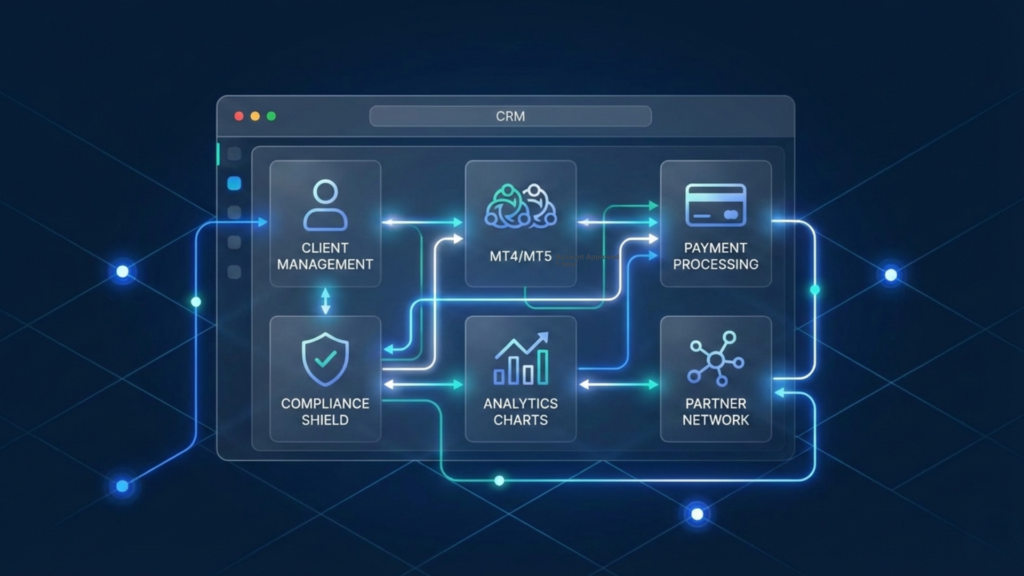
If you’re evaluating CRM systems for your brokerage in 2026, the feature set you need goes well beyond a client database. You need a system that handles compliance automation, multi-platform connectivity, real-time reporting, and partner management—all without requiring a dedicated IT team to maintain it.
This guide breaks down the 10 features that separate a capable forex CRM from one that will hold your brokerage back. For each feature, we explain what it does, why it matters, and what to look for when evaluating vendors.
- 1. Native MT4 and MT5 Integration
- 2. Automated Client Onboarding and KYC
- 3. Comprehensive IB and Partner Management
- 4. Payment Gateway Integration
- 5. Compliance and Regulatory Tools
- 6. Real-Time Reporting and Analytics
- 7. Marketing Automation
- 8. Multi-Language and Multi-Currency Support
- 9. Security and Access Control
- 10. Customization and API Access
- How to Evaluate CRM Features: A Practical Framework
- The Bottom Line
- Frequently Asked Questions
1. Native MT4 and MT5 Integration
The connection between your CRM and trading platform is the most critical integration in your technology stack. Without it, your team spends hours on manual data entry, account creation errors multiply, and client experience suffers.
What to Look For
- Real-time bidirectional sync—Account creation, modification, and status changes should flow automatically between your CRM and MT4/MT5. If your team has to log into the trading platform separately to create accounts, the integration is incomplete.
- Full Manager API access—The CRM should use the MT4 Manager API or MT5 Manager API directly, not a third-party bridge that adds latency and failure points.
- Multi-server support—If you run multiple MT4 or MT5 servers (live, demo, or regional), the CRM should manage all of them from a single interface.
- Trading data visibility—Open positions, account balances, margin levels, and trade history should be visible directly in the CRM without switching to the trading platform admin.
Red flag: If a vendor says their CRM “supports” MT4/MT5 but requires a separate plugin or bridge product, ask exactly what data flows automatically and what requires manual intervention.
For a deeper look at platform-specific considerations, see our guides on MT4 CRM integration and MT5 CRM solutions.
2. Automated Client Onboarding and KYC
Client onboarding is where first impressions are made—and where most brokerages lose potential clients to friction. A modern forex CRM should automate the entire journey from registration to funded account.
What to Look For
- Configurable registration forms—Different jurisdictions and client types require different information. Your CRM should support multiple registration flows without developer involvement.
- Document upload and verification—Clients should be able to upload ID documents, proof of address, and other KYC materials directly through the client portal.
- Automated document verification—Integration with KYC providers like SumSub, Jumio, or Onfido for automatic identity verification. Manual review should be the exception, not the rule.
- Approval workflows—Configurable approval chains where compliance officers review flagged applications while low-risk clients are approved automatically.
- Status tracking—Both your team and the client should see exactly where the onboarding process stands at any moment.
Red flag: If the CRM requires your compliance team to manually check every document and update statuses by hand, you’ll hit a bottleneck as soon as you scale past a few hundred clients.
3. Comprehensive IB and Partner Management
Introducing Brokers (IBs) and affiliates drive a significant portion of client acquisition for most forex brokerages. Your CRM needs to handle the full complexity of multi-tier partner structures.
What to Look For
- Multi-tier commission structures—Support for CPA (cost per acquisition), revenue share, spread markup, lot rebate, and hybrid models. Many brokerages use different structures for different partner tiers.
- Real-time commission calculation—Commissions should be calculated automatically based on trading activity, not manually at the end of each month.
- Partner portal—A dedicated interface where IBs can track their referrals, commissions, marketing materials, and sub-partner performance.
- Sub-IB management—Support for multi-level partner hierarchies where master IBs manage their own networks of sub-partners.
- Automated payouts—Commission payments should be processed automatically based on configurable rules and schedules.
Red flag: If the CRM only supports flat CPA commissions, it won’t work for brokerages with complex IB networks—which is most brokerages operating in Asia, the Middle East, or Africa.
4. Payment Gateway Integration
Your clients expect fast, reliable deposits and withdrawals. The CRM should connect to multiple payment providers and manage the entire fund flow.
What to Look For
- Multiple gateway support—Bank wire, credit/debit cards, e-wallets (Skrill, Neteller), cryptocurrency, and region-specific methods. No single payment provider covers every market.
- Automated deposit processing—When a client deposits funds, the CRM should automatically credit their trading account without manual intervention.
- Withdrawal workflow—Configurable approval rules for withdrawals, including automatic approval for amounts below a threshold and manual review for larger amounts.
- Multi-currency handling—Support for deposits and withdrawals in multiple currencies with automatic conversion where needed.
- Transaction history—Complete audit trail of all financial transactions, accessible to both clients and your back-office team.
Red flag: If adding a new payment provider requires custom development every time, the CRM’s payment architecture is too rigid. Look for systems with a plugin-based payment gateway framework.
For more on connecting payment systems to your trading platform, see our guide on MT4/MT5 integration services.
5. Compliance and Regulatory Tools
Regulatory requirements are getting stricter every year. Your CRM should make compliance easier, not harder.
What to Look For
- Jurisdiction-specific workflows—Different regulators (CySEC, FCA, ASIC, FSCA) have different requirements. The CRM should support configurable compliance rules per jurisdiction.
- Automated risk profiling—Appropriateness and suitability assessments built into the onboarding flow, with automatic scoring and flagging.
- AML monitoring—Transaction monitoring rules that flag suspicious activity based on configurable thresholds.
- Regulatory reporting—Built-in or easily exportable reports that match your regulator’s requirements.
- Audit trail—Every action in the CRM should be logged with timestamps, user IDs, and before/after values. This is non-negotiable for regulated brokerages.
- Data retention policies—Configurable data retention and deletion rules to comply with GDPR and other privacy regulations.
Red flag: If the vendor can’t demonstrate compliance features specific to your regulatory jurisdiction, they likely haven’t built for regulated brokerages.
6. Real-Time Reporting and Analytics
You can’t manage what you can’t measure. A forex CRM should give you real-time visibility into every aspect of your brokerage operations.
What to Look For
- Dashboard customization—Different roles need different views. Your CEO needs high-level KPIs, your sales team needs pipeline metrics, and your compliance officer needs risk indicators.
- Real-time data—Deposit volumes, active traders, new registrations, and partner performance should update in real time, not with a 24-hour delay.
- Cohort analysis—The ability to analyze client behavior by acquisition source, registration date, geography, or account type.
- Revenue analytics—Breakdown of revenue by client segment, trading instrument, partner channel, and time period.
- Export capabilities—Data should be exportable to CSV, Excel, or via API for integration with business intelligence tools.
Red flag: If the CRM only offers pre-built reports with no customization, you’ll outgrow it quickly. Every brokerage has unique reporting needs.
7. Marketing Automation
Client acquisition doesn’t end at registration. Your CRM should help convert leads into funded accounts and keep existing clients active.
What to Look For
- Email campaign management—Automated email sequences triggered by client actions (registration, first deposit, inactivity, birthday).
- Lead scoring—Automatic prioritization of leads based on engagement, deposit potential, and behavior patterns.
- Segmentation—The ability to segment clients by any combination of attributes: geography, account type, trading volume, deposit amount, activity level.
- SMS and push notifications—Multi-channel communication capabilities beyond just email.
- Campaign analytics—Open rates, click rates, conversion rates, and revenue attribution for every campaign.
Red flag: If the CRM’s “marketing” feature is just a bulk email sender with no automation or segmentation, it won’t help you scale client engagement.
8. Multi-Language and Multi-Currency Support
Forex is a global business. If you’re operating in multiple markets—or plan to—your CRM needs to support that from day one.
What to Look For
- Full interface localization—The client portal, back-office interface, and all communications should be available in your target languages. Not just the client-facing side—your support team in different regions needs localized tools too.
- RTL language support—If you serve Arabic, Hebrew, or Farsi-speaking markets, right-to-left text rendering is essential.
- Multi-currency accounting—Client balances, commission calculations, and reporting should handle multiple currencies natively, not through workarounds.
- Regional payment methods—The system should support payment providers specific to each market you operate in.
- Timezone handling—Reports, scheduled actions, and client communications should respect local timezones.
Red flag: If the vendor offers “multi-language support” but it’s limited to the client portal login page, that’s not real localization.
9. Security and Access Control
A forex CRM contains sensitive financial and personal data. Security isn’t optional—it’s foundational.
What to Look For
- Role-based access control (RBAC)—Granular permissions that control exactly what each team member can see and do. Your sales team shouldn’t have access to withdrawal approvals, and your support team shouldn’t see commission structures.
- Two-factor authentication—For both the back-office interface and the client portal.
- IP whitelisting—The ability to restrict back-office access to specific IP addresses or VPN connections.
- Data encryption—Encryption at rest and in transit for all sensitive data, including personal information and financial records.
- Activity logging—Complete audit trail of all user actions, including login attempts, data changes, and system access.
- Regular security updates—The vendor should have a documented security update schedule and vulnerability response process.
Red flag: If the vendor can’t provide a SOC 2 report, penetration test results, or at minimum a detailed security whitepaper, treat that as a serious concern.
10. Customization and API Access
No two brokerages operate exactly the same way. Your CRM should adapt to your workflow, not the other way around.
What to Look For
- Custom fields—The ability to add custom data fields to client profiles, accounts, and transactions without developer involvement.
- Workflow automation—Configurable business rules that trigger actions based on events (e.g., automatically assign a retention manager when a client’s balance drops below a threshold).
- RESTful API—A well-documented API that allows you to build custom integrations, extract data, and extend functionality.
- Webhook support—Real-time event notifications that trigger actions in external systems.
- White-label capability—The ability to brand the client portal with your own logo, colors, and domain.
- Plugin architecture—A modular system where new features can be added without modifying the core platform.
Red flag: If every customization requires a change request to the vendor’s development team with a 4–6 week turnaround, you’ll be constantly waiting instead of executing.
For guidance on selecting the right vendor, see our forex CRM provider selection guide.
How to Evaluate CRM Features: A Practical Framework
Having a feature checklist is useful, but knowing how to evaluate those features during the vendor selection process is what separates a good decision from a costly mistake.
Step 1: Map your requirements to your business model. A brokerage focused on institutional clients has different CRM needs than one targeting retail traders in emerging markets. Start by listing your top 5 operational pain points—the CRM should address at least 4 of them.
Step 2: Request a sandbox environment, not just a demo. A guided demo shows you what the vendor wants you to see. A sandbox lets you test real workflows with your own data. Any serious vendor will provide one.
Step 3: Test the integration depth. Connect the CRM to your MT4/MT5 server in the sandbox. Create accounts, process deposits, run reports. If the integration breaks or requires manual steps, that’s what your team will deal with every day.
Step 4: Check the API documentation. Open the API docs before signing a contract. If the documentation is sparse, outdated, or non-existent, custom integrations will be painful.
Step 5: Ask about the upgrade path. How often does the vendor release updates? How are they deployed? Will updates break your customizations? A CRM that’s difficult to upgrade becomes a liability over time.
For a broader perspective on choosing the right system, read our guides on choosing a forex CRM solution and forex CRM software options.
The Bottom Line
The right forex CRM is the operational backbone of your brokerage. It connects your trading platform, payment systems, compliance workflows, and client management into a single system that your team actually wants to use.
When evaluating CRM systems in 2026, don’t just compare feature lists. Test the features that matter most to your specific business model, verify the integration depth with your trading platform, and make sure the system can grow with you.
If you’re looking for a forex CRM built specifically for brokers, we’d be happy to show you how our system handles each of these 10 features. Book a free consultation to discuss your requirements.
Frequently Asked Questions
This article is for informational and educational purposes only and does not constitute legal, financial, or regulatory advice. Regulatory requirements, costs, and timelines vary by jurisdiction and are subject to change. Always consult qualified legal counsel and compliance professionals before making business decisions. DivulgeTech LTD assumes no liability for actions taken based on the information in this article.