


The True Cost of Forex CRM: Build vs Buy Analysis
A transparent breakdown of SaaS subscription fees vs custom development — hidden costs, 5-year TCO, and the break-even point for your brokerage.
- Introduction
- What You Are Actually Paying For
- SaaS Forex CRM Pricing: What Vendors Charge
- Custom Forex CRM Development Costs
- Total Cost of Ownership: 5-Year Comparison
- Hidden Costs That Distort the Comparison
- When the Economics Favour Each Model
- How to Evaluate a CRM Quote Accurately
- What DivulgeTech Delivers for Custom CRM Projects
- Conclusion
- Frequently Asked Questions
Introduction
Forex CRM cost is one of the most searched — and least honestly answered — questions in the brokerage technology space. Vendors rarely publish pricing. When they do, the headline number rarely reflects what brokerages actually pay once setup fees, per-user charges, integration costs, and annual increases are factored in.
This article provides a transparent, numbers-driven breakdown of what forex CRM systems actually cost across both models: SaaS subscriptions and custom development. We cover upfront costs, recurring costs, hidden charges, and total cost of ownership over a five-year horizon — so you can make the decision based on real economics rather than vendor marketing.
If you are still deciding between the two approaches, our custom forex CRM vs SaaS comparison covers the strategic dimensions beyond cost.
What You Are Actually Paying For
A forex CRM’s cost structure comprises six components: technology infrastructure, software development, maintenance, integrations, support, and user licences. In SaaS, most are bundled into the subscription; in custom builds, each is scoped and priced separately.
Before breaking down numbers, it helps to understand the cost components that apply to any forex CRM, regardless of whether it is SaaS or custom-built.
Technology infrastructure — Servers, databases, hosting, and network infrastructure that runs the system. In SaaS, this is bundled into the subscription. In custom, you provision and pay for it directly.
Software development — The code that makes the CRM work. In SaaS, you are paying a share of the vendor’s ongoing development costs as part of your subscription. In custom, you commission development and own the result.
Maintenance and updates — Bug fixes, security patches, platform upgrades, and compatibility maintenance. In SaaS, this is included. In custom, you budget for it explicitly.
Integration work — Connecting the CRM to MT4/MT5, payment gateways, KYC providers, and other systems. This is almost always a separate cost in SaaS and is scoped into the development budget in custom builds.
Support — Access to technical and operational support. In SaaS, support tiers are often tied to subscription level. In custom, support terms are defined in your maintenance agreement.
User licences — SaaS platforms frequently charge per seat or per active user. Custom systems have no per-user licensing cost once built.
Understanding these components makes it much easier to compare quotes accurately — and to spot the costs that vendors do not mention upfront.
SaaS Forex CRM Pricing: What Vendors Charge
SaaS forex CRM costs range from $999/month for entry-level platforms to $25,000+/month for enterprise systems. Most established brokerages pay $3,000–$10,000 per month before add-on charges.
SaaS forex CRM pricing varies significantly depending on vendor, tier, and negotiation. Based on publicly available information and market research, the following ranges apply as of 2026.
Entry-Level SaaS Platforms
Entry-level SaaS CRMs targeting smaller or newer brokerages typically price between $999 and $2,500 per month. At this tier, you typically get:
- Core client management and back-office functions
- MT4 or MT5 integration (sometimes at an additional cost)
- Basic IB management (flat CPA commissions only)
- Limited number of back-office user seats (typically 5–10)
- Standard payment gateway connectors (2–3 providers)
- Email support with 24–48 hour response times
What you generally do not get at entry-level: multi-tier IB structures, advanced compliance workflows, dedicated account managers, custom reporting, or API access.
Mid-Tier SaaS Platforms
Mid-tier platforms targeting established brokerages range from $3,000 to $8,000 per month. This tier typically includes:
- Full MT4/MT5 integration with multi-server support
- Multi-level IB management with configurable commission structures
- KYC workflow management (often without automated verification)
- Multiple payment gateway integrations
- Expanded user seats (20–50 users)
- Custom reporting and dashboards
- Phone or live chat support
At this tier, brokerages begin encountering per-integration fees. Adding a new payment provider, KYC verification partner, or trading platform connection typically costs $2,000–$10,000 per integration plus ongoing connector fees.
Enterprise SaaS Platforms
Enterprise-grade platforms — those targeting multi-jurisdiction brokerages with complex operations — start at $8,000 per month and frequently exceed $15,000–$25,000 per month at full deployment. Enterprise tiers add:
- Unlimited or high user seat counts
- Dedicated infrastructure (private cloud tenancy)
- Custom compliance workflows per jurisdiction
- White-label client portal with full branding
- SLA-backed uptime guarantees
- Dedicated customer success and technical account managers
- Professional services for custom integrations
Even at enterprise pricing, most SaaS platforms restrict access to underlying data, limit API usage, and retain control over platform architecture decisions.
Common SaaS Add-On Charges
Beyond the monthly subscription, the following add-on charges appear regularly in SaaS contracts:
| Add-On | Typical Cost |
|---|---|
| Setup and onboarding fee | $5,000 – $25,000 (one-time) |
| Custom integration (per connector) | $2,000 – $15,000 (one-time) |
| Per-user overage (above seat limit) | $50 – $200 per user/month |
| Additional MT4/MT5 server connection | $500 – $2,000/month |
| Premium KYC provider integration | $500 – $3,000/month |
| API access tier upgrade | $500 – $2,000/month |
| Data export / migration assistance | $2,000 – $10,000 (one-time) |
| Annual price increase (typical) | 8 – 15% per year |
Annual price increases deserve particular attention. Most SaaS contracts include a clause permitting annual fee increases in line with CPI or at the vendor’s discretion. On a $5,000/month starting subscription with a 10% annual increase, your monthly cost reaches $7,320 by year five — a 46% increase for the same service.
Custom Forex CRM Development Costs
A professional custom forex CRM for a mid-sized brokerage costs $80,000–$150,000 to build initially. Ongoing maintenance and hosting runs $25,000–$75,000 per year, making total five-year cost typically lower than comparable SaaS.
Custom forex CRM development cost depends on scope, the development partner you choose, and your specific requirements. The following ranges reflect professional development by experienced forex technology teams — not offshore commodity development.
Phase 1: Discovery and Architecture
Before a line of code is written, a serious custom CRM project requires a discovery and architecture phase: mapping your workflows, defining data models, scoping integrations, and producing a technical specification. This phase typically costs $5,000–$15,000 and takes two to four weeks.
Skipping this phase is a false economy. Ambiguous requirements are the primary driver of custom software cost overruns.
Phase 2: Core Development
Core development covers the foundational system: client portal, back-office interface, MT4/MT5 integration, user authentication and permissions, and the basic data model. For a forex CRM covering the 10 essential features a modern brokerage needs, core development typically takes three to five months and costs $40,000–$100,000 depending on complexity and team composition.
Key scope variables that drive cost upward:
- Multi-jurisdiction compliance requirements (adds 15–25% to scope)
- Multi-language interface support (adds 10–20% depending on language count)
- Complex IB commission structures (adds $10,000–$20,000 to scope)
- Multiple trading platform integrations beyond MT4/MT5 (adds $10,000–$25,000 per platform)
Phase 3: Integrations
Payment gateway integrations, KYC provider connectivity, email/SMS systems, and third-party data feeds are typically scoped and priced separately. Common integration costs:
| Integration | Typical Development Cost |
|---|---|
| MT4/MT5 Manager API | $8,000 – $20,000 |
| Payment gateway (per provider) | $3,000 – $8,000 |
| KYC/identity verification provider | $5,000 – $12,000 |
| Email/SMS automation platform | $2,000 – $5,000 |
| Crypto payment processor | $5,000 – $15,000 |
| Regulatory reporting API | $5,000 – $15,000 |
A typical mid-sized brokerage CRM with MT4/MT5, three payment gateways, and one KYC provider adds $25,000–$60,000 to the core development cost in integrations.
Phase 4: Testing and Launch
Quality assurance, security testing, user acceptance testing, staging deployment, and production launch typically cost $8,000–$20,000 and take four to six weeks.
Total Initial Investment
Combining all phases, a professional custom forex CRM for a mid-sized brokerage typically requires an initial investment of $80,000–$150,000. More complex systems — multi-jurisdiction, multi-platform, with advanced reporting and compliance tooling — can reach $200,000–$350,000.
Ongoing Maintenance and Hosting
After launch, custom CRM owners carry the following recurring costs:
| Cost Component | Annual Range |
|---|---|
| Maintenance and support retainer | $15,000 – $35,000/year |
| Infrastructure / hosting (cloud servers) | $6,000 – $24,000/year |
| Security and compliance updates | $5,000 – $15,000/year |
| Feature additions and enhancements | $10,000 – $50,000/year (elective) |
The non-elective recurring costs (maintenance, hosting, security) typically run $25,000–$75,000 per year — equivalent to $2,100–$6,250 per month. Feature additions are elective and vary based on your roadmap.
Total Cost of Ownership: 5-Year Comparison
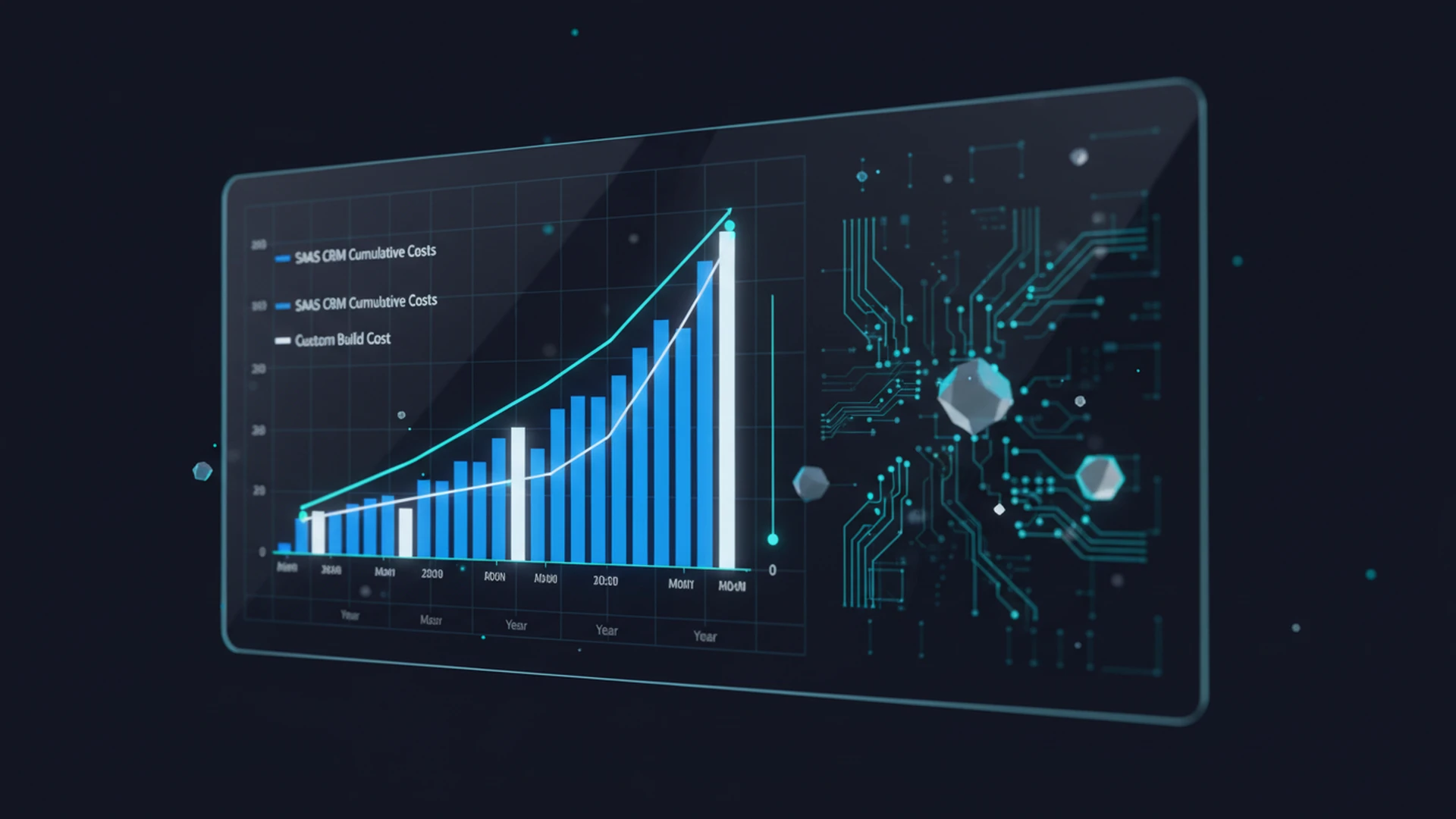
Over a five-year period, a custom forex CRM typically costs $320,000 in total versus $381,000+ for a comparable SaaS subscription — with the break-even point at approximately 30–36 months.
The build vs buy cost debate is most clearly resolved by comparing total cost of ownership (TCO) over a five-year period — the typical planning horizon for a brokerage’s technology stack.
Scenario: Mid-Sized Brokerage, 30 Back-Office Users
SaaS CRM (mid-tier, $5,000/month starting, 10% annual increase):
| Year | Monthly Fee | Annual Cost | Cumulative |
|---|---|---|---|
| 1 | $5,000 | $60,000 + $15,000 setup = $75,000 | $75,000 |
| 2 | $5,500 | $66,000 | $141,000 |
| 3 | $6,050 | $72,600 | $213,600 |
| 4 | $6,655 | $79,860 | $293,460 |
| 5 | $7,320 | $87,840 | $381,300 |
5-year SaaS TCO: ~$381,000 (not including add-on integrations, overage fees, or support escalations)
Custom CRM (initial build $120,000, ongoing $40,000/year):
| Year | Cost | Cumulative |
|---|---|---|
| 1 | $120,000 (build) + $40,000 (ongoing) | $160,000 |
| 2 | $40,000 | $200,000 |
| 3 | $40,000 | $240,000 |
| 4 | $40,000 | $280,000 |
| 5 | $40,000 | $320,000 |
5-year Custom TCO: ~$320,000 (you own the system; ongoing cost does not increase with usage)
The break-even point in this scenario falls around month 30–36. After that, the custom CRM consistently costs less per year than the SaaS equivalent — while delivering a system designed specifically for your operations rather than a shared platform.
For brokerages operating at scale, the savings compound further. SaaS fees typically increase with user count, trading volume, or active client numbers. Custom CRM running costs do not scale linearly with brokerage growth.
Hidden Costs That Distort the Comparison
The most significant hidden costs in SaaS contracts are vendor exit fees ($20,000–$80,000), customisation charges at proprietary hourly rates, and annual price increases of 8–15%.
The TCO comparison above uses transparent numbers. Real-world decisions are complicated by costs that are often not discussed upfront.
Hidden SaaS Costs
Vendor lock-in exit cost — Migrating away from a SaaS CRM is expensive. You typically need to negotiate a data export (often charged separately), rebuild integrations for a new platform, retrain your team, and manage the operational disruption of switching. Migration projects frequently cost $20,000–$80,000 and take three to six months.
Customisation ceiling — When SaaS platforms reach their configuration limits and you need bespoke functionality, vendors either say no or charge professional services rates ($150–$300/hour) for modifications that remain in the vendor’s codebase — not yours.
Pricing renegotiation leverage — Once your operations depend on a SaaS platform, your negotiating position at contract renewal is weak. Vendors know the cost of switching. Price increases are difficult to resist without threatening a migration you probably cannot afford quickly.
Data access limitations — Many SaaS platforms restrict bulk data export or charge for it. If your business intelligence team needs raw data, you may be paying for data access to your own operational data.
Hidden Custom Development Costs
Scope creep — Requirements that expand during development are the most common cost driver on custom projects. A disciplined discovery phase and fixed-scope contracts mitigate this but do not eliminate it entirely.
Internal resource cost — Someone at your brokerage needs to manage the development relationship, review deliverables, and handle user acceptance testing. This is a real cost that is rarely budgeted explicitly.
Knowledge transfer risk — If the development partner closes, is acquired, or experiences team turnover, institutional knowledge of your codebase is at risk. Mitigate this with comprehensive documentation requirements built into the contract.
Slower feature availability — When a SaaS vendor adds a valuable new feature, all subscribers get it. On a custom system, new features require scoping, budgeting, and building.
When the Economics Favour Each Model
The cost analysis points toward different conclusions depending on your situation.
SaaS is the lower-risk economic choice when:
- You are launching with uncertain growth projections
- You need to be operational within 60 days
- Your operational requirements are standard (no unusual IB structures, single jurisdiction, standard KYC)
- You have fewer than 15 back-office users
- Your planning horizon is under two years
Custom development is the lower-cost long-term choice when:
- You project 1,000+ active clients within 18 months
- You have non-standard requirements that would require expensive SaaS customisation
- You are already paying $5,000+ per month for a SaaS CRM and still hitting limitations
- You have 25+ back-office users (per-seat SaaS costs compound quickly)
- You intend to operate the same technology stack for five or more years
For a full strategic comparison that goes beyond cost, read our custom forex CRM vs SaaS decision guide.
How to Evaluate a CRM Quote Accurately
Whether you are receiving a SaaS proposal or a custom development estimate, the following questions will give you a more accurate total cost picture.
For SaaS vendors: 1. What is your annual price increase policy — is it CPI-linked, fixed percentage, or at your discretion? 2. What is the per-seat cost above the included user count? 3. Which integrations are included and which are charged separately? 4. What does a full data export cost if we decide to migrate? 5. What are the contract termination terms and notice period? 6. Can you provide three client references in our regulatory jurisdiction?
For custom development partners: 1. Is this a fixed-price contract or time-and-materials? (Fixed-price is strongly preferable for defined-scope work.) 2. What is included in the post-launch maintenance retainer and what triggers additional charges? 3. Who owns the codebase, and do we receive all source code on delivery? 4. What documentation is produced and maintained throughout the project? 5. What is your process for handling change requests that arise during development? 6. Who holds the technical architecture knowledge — one person, or is it distributed across your team?
Getting clear answers to these questions before signing any contract will prevent the majority of cost surprises that brokerages encounter after the fact.
What DivulgeTech Delivers for Custom CRM Projects
DivulgeTech builds bespoke forex CRM systems for brokerages using open-source technology. This means our clients avoid proprietary licensing fees entirely — there is no recurring software licence, no per-seat fee, and no vendor ecosystem to be locked into.
Our projects are delivered on fixed-price contracts covering a defined scope, with full source code ownership transferred to the client on completion. Maintenance retainers are optional, and clients are free to manage the system internally or through any third-party team.
For brokerages evaluating whether custom development makes economic sense for their situation, we offer a free technical consultation that covers scope estimation, timeline, and realistic cost ranges — without the sales pressure to over-scope the project.
Book a free consultation if you would like a candid assessment of what a custom forex CRM would cost for your specific requirements.
Conclusion
The true cost of forex CRM is almost always higher than the headline number — whether that number is a monthly SaaS fee or a custom development quote. The decision is not which option is cheaper upfront, but which option delivers better value over the horizon that matters for your business.
For most brokerages, the break-even point between SaaS and custom falls within two to three years. Beyond that, custom development consistently produces lower annual costs, greater operational control, and a system that is an asset rather than an ongoing liability.
The worst outcome is not choosing SaaS over custom or vice versa. The worst outcome is choosing the wrong model for your current stage, then paying the cost — financial and operational — of switching later.
If you are currently evaluating options, explore our guide to the best forex CRM systems to understand the SaaS landscape, or contact our team to discuss whether a custom build is the right move for your brokerage.
This article is for informational and educational purposes only. It does not constitute legal, financial, or regulatory advice. Cost figures are indicative estimates based on market research and may vary significantly by vendor, scope, and jurisdiction. Always conduct independent due diligence before making procurement or investment decisions. DivulgeTech LTD assumes no liability for actions taken based on the information in this article.
Related Articles
- Custom Forex CRM vs SaaS: Which Is Right for Your Brokerage?
- Custom Forex CRM System: What It Is and When to Build One
- 10 Essential Forex CRM Features Every Broker Needs in 2026
- Best Forex CRM Systems for Brokers in 2026